
Analysis of issues that interest you!
WHAT WILL YOU FIND ON GZINTAS.COM?
The purpose of this website is to present the results of analytical applications by Dave Mason (with occasional associates) in the form of informal papers. They address a range of topics, issues, questions, whatever … that may be of interest to the general public. Many relate to sporting activities. The full papers, in standard 8.5” x 11” format, can be downloaded as a PDF.
Below is a list of the papers currently available on this website. Click the Paper No. to scroll down for the Abstract and other details, as well as a link to download the full paper. Other papers will be added from time to time.
LIST OF PAPERS
Paper No. / Category / TITLE
GZ-2026-01 / Hockey / DRAFT STEALS AND BUSTS: WHICH NATIONAL HOCKEY LEAGUE TEAMS HAVE DRAFTED BEST SINCE 2000?
GZ-2026-02 / Baseball / IN SEARCH OF THE RIGHT AVERAGE FOR BASEBALL
GZ-2026-03 / Sports (Hockey) / THE ADVANTAGES OF BLOCK SCHEDULING METHODS FOR PROFESSIONAL SPORTS LEAGUES USING THE NATIONAL HOCKEY LEAGUE AS AN EXAMPLE
GZ-2026-04 / Hockey / CHARACTERIZING STANLEY CUP CHAMPIONS IN THE SALARY CAP ERA, 2006 TO 2026
GZ-2020-01 / Pandemic Response / MINIMIZING TOTAL TEST REQUIREMENTS WHEN TESTING A POPULATION DURING A PANDEMIC
GZ-2026-05 / Sports (Hockey) / THE RATIONALE FOR THE NATIONAL HOCKEY LEAGUE ADOPTING THE 3-2-1-0 POINT SYSTEM
Thinking About It / Sports – How real is home field advantage across major professional sports?
Also Thinking About / Hockey – How early is too early to pull the goalie?
And pondering / Baseball – Can we truly determine the best hitters and pitchers of all time?

Paper: GZ-2026-01 Back to list
Title: DRAFT STEALS AND BUSTS: WHICH NATIONAL HOCKEY LEAGUE TEAMS HAVE DRAFTED BEST SINCE 2000?
Author: David Wright Mason
Date Published: June 2026
Updated: n/a
Abstract: National Hockey League teams place a huge emphasis on scouting. The conventional wisdom is that a team builds for long term success by making shrewd picks in the annual entry draft. Sure, a team also can build through deft trades and key free-agent signings, but in the salary cap era of today the NHL entry draft is considered even more important to get right. This paper presents the top steals and busts in drafts since 2000, and assesses which franchises have done well - or not so well - in drafting.

Paper: GZ-2026-02 Back to list
Title: IN SEARCH OF THE RIGHT AVERAGE FOR BASEBALL
Author: David Wright Mason
Date Published: July 2026
Updated: November 2026
Abstract: Baseball has struggled to identify a statistic that best represents the essence of batter or pitcher performance. This paper begins by asking the question: If a Single is worth 1 – as it is in the traditional trio of Batting Average, On-Base Percentage, and Slugging Percentage – what is a Walk worth, or a Double, Triple, or Home Run? Past quantitative approaches by baseball researchers have been investigated, in particular George Lindsey’s Run Expectancy calculations in 1963, Pete Palmer’s Linear Weights concept in 1984, and Tom Tango’s weighted on-base average in 2006. This paper builds on Lindsey’s concepts, streamlines Palmer’s and Tango’s work, and focuses on just those key inputs that the traditional trio employs. A single measure of overall batter performance – the “Single Equals One Average”, or simply “S1 Average” – is proposed as the right average for baseball. This average has the attractive property that it doubles as a pitcher performance metric as well.
Paper: GZ-2026-03 Back to list
Title: THE ADVANTAGES OF BLOCK SCHEDULING METHODS FOR PROFESSIONAL SPORTS LEAGUES USING THE NATIONAL HOCKEY LEAGUE AS AN EXAMPLE
Author: David Wright Mason
Date Published: August 2026
Updated: n/a
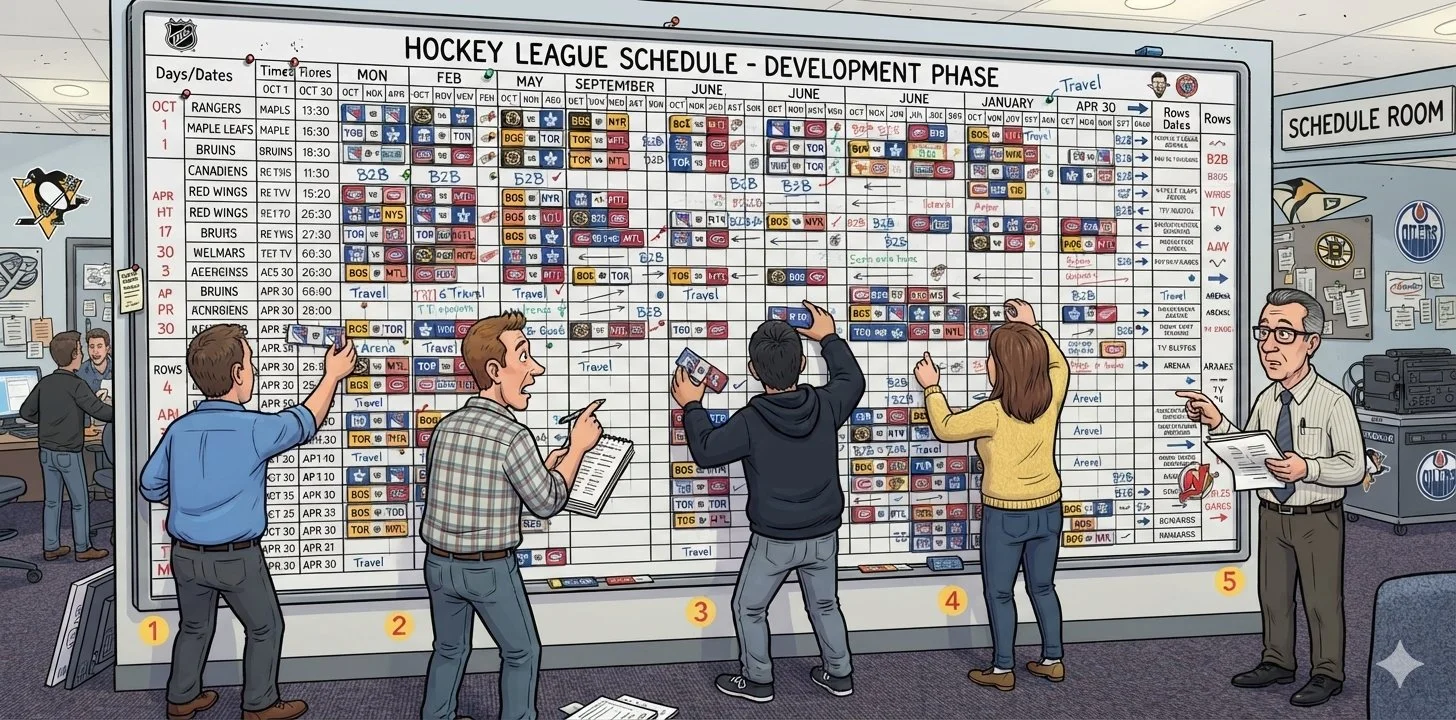
Abstract: Establishing an annual schedule for large professional sporting leagues is a considerable challenge. Despite having numerous constraints – such as date restrictions for the game facilities, requirements to play special games, obligations under broadcasting contracts, collective agreement restrictions, desired limits on road trips, etc. – this does not force scheduling to be a completely manual process. Block scheduling methods can take advantage of the league structure to enable the construction of a very useful starting point for building a full league schedule. These possibilities are illustrated by producing a full block schedule for the National Hockey League regular season.
Paper: GZ-2026-04 Back to list
Title: CHARACTERIZING STANLEY CUP CHAMPIONS IN THE SALARY CAP ERA, 2006 TO 2026
Author: David Wright Mason
Date Published: September 2026
Updated: n/a
Abstract: Under the National Hockey League’s salary cap structure one can no longer buy a Stanley Cup victory. There are no hockey equivalents to baseball’s New York Yankees or Los Angeles Dodgers. Multiple factors need to come together for a team to win Lord Stanley’s coveted cup. The player roster assembled by the franchise’s management team is always going to be the key component to winning championships. What characteristics does a winning roster have that others do not, and what style of play wins titles? Does offence or defence win championships? Do you have to build through the draft? How important is a first-round draft pick? Can you win by squeaking into the playoffs and hoping you’re better at “playoff hockey”? Are superstars or hot goaltending essential to victory? How well does tanking a season or two to get some high draft picks actually work? Lots of questions! We will do some gzintas, and try to shine some light into these dark corners.
Paper: GZ-2020-01 Back to list
Title: MINIMIZING TOTAL TEST REQUIREMENTS WHEN TESTING A POPULATION DURING A PANDEMIC
Authors: David W. Mason and Andrew M. Mason
Date Published: April 2020
Updated: October 2026
Abstract: The Coronavirus pandemic placed high demands on a population’s ability to handle the volume of blood tests required. Some nations resorted to combining blood from samples collected from a number of individuals and then testing the combined sample for the Coronavirus sequence. This is helpful if the proportion of expected positives is low. If a combined sample comes back negative then every individual in the grouping can be declared clean. If it returns a positive then everyone’s sample has to be tested individually, as would have been done anyway without grouping. Therefore, creating combined samples would appear to offer the ability to significantly reduce the total number of tests required in demanding pandemic circumstances. But how large should the groupings be? Intuitively, it would seem to depend on the expected likelihood of an individual testing positive, but what is that relationship? This treatise shows that if the expected likelihood of a positive test is 1 in every X individuals, then the optimum batch size is the square root of X.

Paper: GZ-2026-05 Back to list
Title: THE RATIONALE FOR THE NATIONAL HOCKEY LEAGUE ADOPTING THE 3-2-1-0 POINT SYSTEM
Authors: David Wright Mason
Date Published: November 2026
Updated: N/A
Abstract: The National Hockey League uses the 2-2-1-0 point system – two points for a win in regulation time, two points for a win in either overtime or a subsequent shoot-out, one point for an extra-time loss, and zero points for a regulation time loss. It evolved over the past four decades from the legacy “two points for win, one point each for a tie” system as the result of the NHL trying to add some excitement in resolving the “non-result” of a tied game. However other leagues and organizations, including the International Ice Hockey Federation, the elite professional leagues in Europe, as well as the National Collegiate Athletic Association and Professional Women’s Hockey League in North America have adopted the 3-2-1-0 system, where the winner in regulation time is awarded three points. This paper details the major issues with the 2-2-1-0 point system and presents the rationale for change.
Have a question or comment about the papers on GZintas.com?
Get in touch below …